Who is this agent?
Identity
Its own core, working context, history and private archive.
Ownpast is an AI Identity Runtime: a local-first system that gives AI agents persistent memory and identity continuity across sessions. It keeps an agent's memory, journal, history and session lifecycle on your own machine, so the identity does not start from zero every time a new session begins.
For example: on Monday you correct how your agent runs the tests. On Friday, in a new session, the agent recalls that correction as soon as the task touches the tests, and you can open the markdown file where it is kept and see when it was written and changed.
A conversation is temporary. An identity should not be.
The model is the reasoning engine. Ownpast provides the continuity around it: what the identity remembers, what it has experienced, what it has learned, and the context it carries into its next session. The model can change; the identity's stored history and memory can remain. A small core and the relevant memory indexes are made available at session start, while specific memories are recalled when the task calls for them.
Who is this agent?
Its own core, working context, history and private archive.
What does it remember?
Layered knowledge that can be recalled, used, evaluated and maintained.
What happened?
A repeatable flow from session start through work to session-end reflection and journaling.
How reliable is its memory?
Review and maintenance that can propose corrections, merges, moves and other changes for approval.
How does the identity change over time?
The longer-term direction for reflecting on decisions, commitments, recurring patterns and changes in self-understanding. A conceptual direction, not yet implemented.
The agent decides what to remember and writes it; Ownpast saves it, puts the right memory in front of the agent at the right moment, and helps keep it tidy. Everything stays on your machine, in plain files, and every save or change is a Git commit.
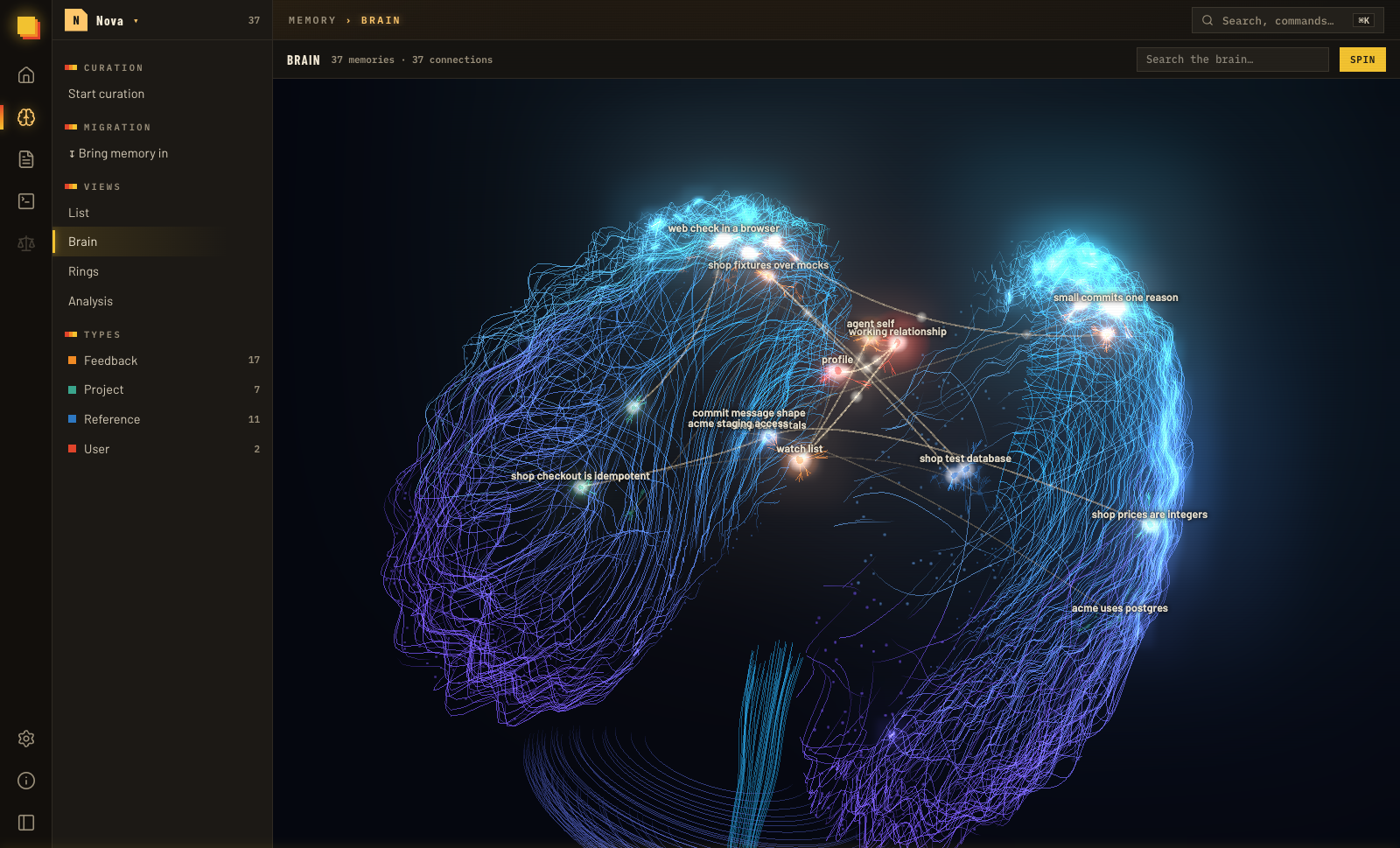
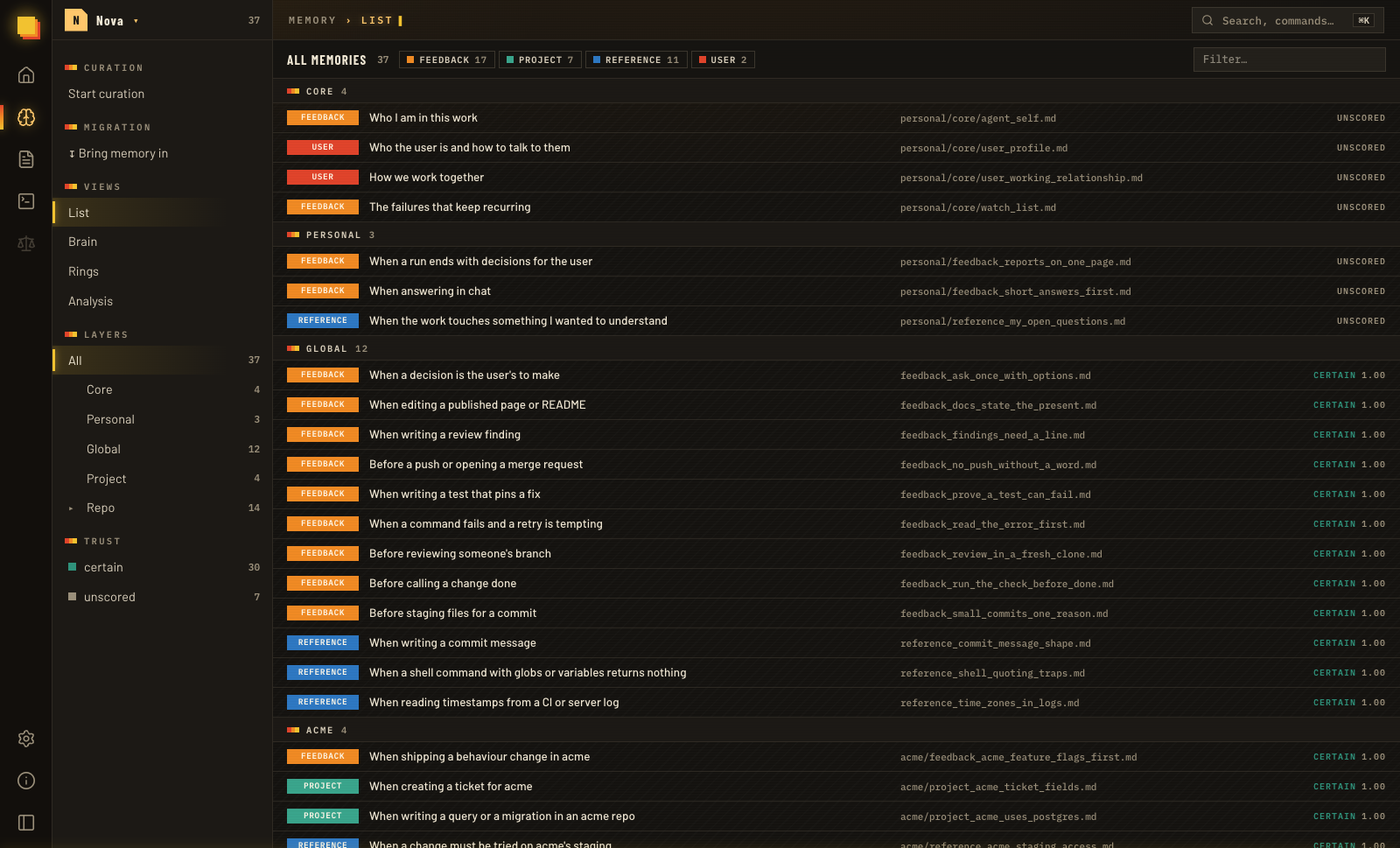
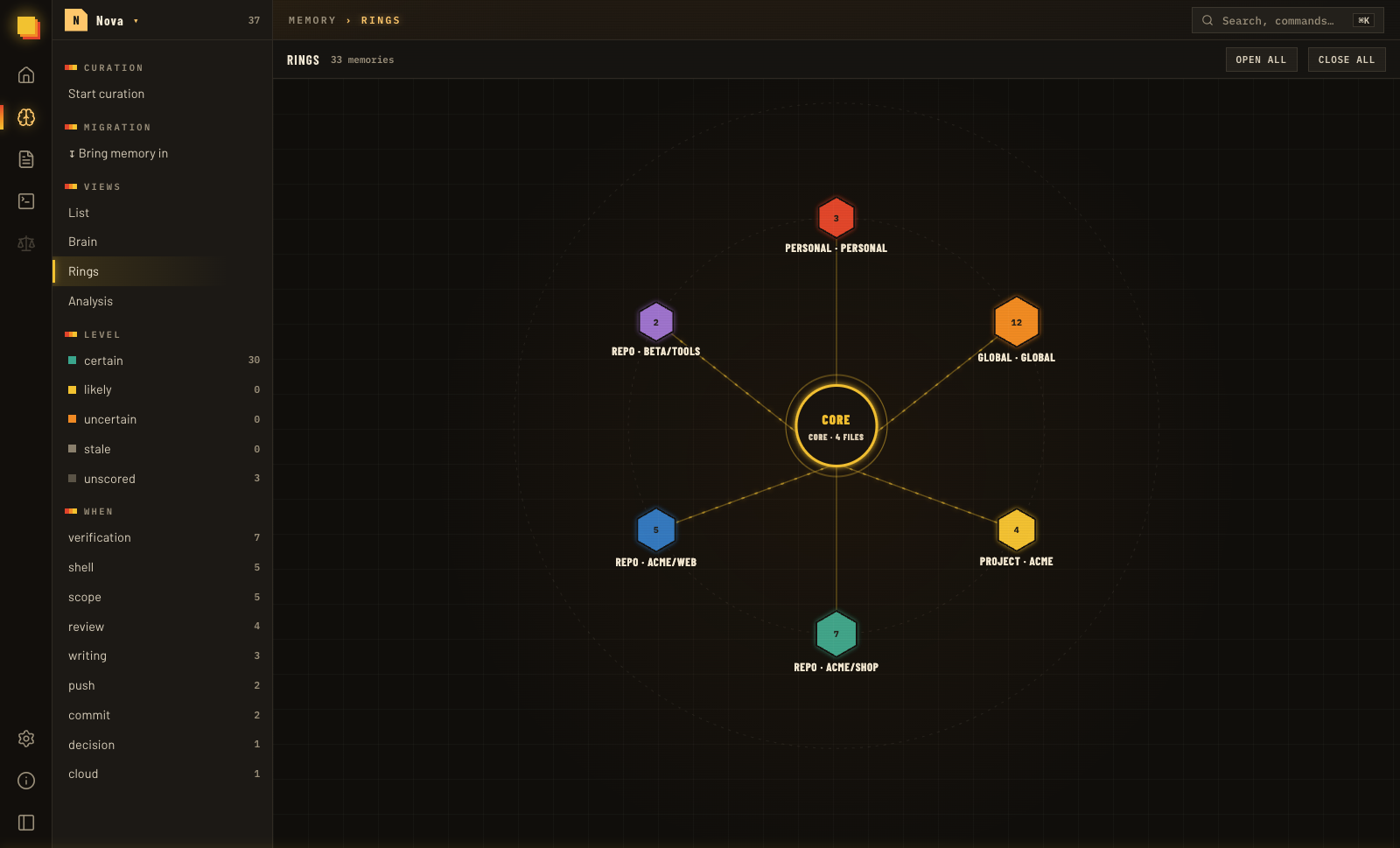
A memory is a short markdown file with a trigger: when to recall it. It lives at the level it is true for: everywhere, a group of repos, one repo, or the personal layer about the user, with a small core read at every session start.
Hooks show the agent the core and the triggers that fit the repo it works in, and hand it a memory when it opens one. Each memory outside the personal layer carries a score that fades with age unless it is confirmed or proves right in use.
At session start, a compact core and memory indexes instead of the entire archive. At session end, the agent records what happened and what it learned, evaluates the memories it used, and writes a journal entry and session report.
A mechanical check and a report propose merges, moves, trims and fixes; you decide each one on a page, and the agent applies them as commits you can undo.
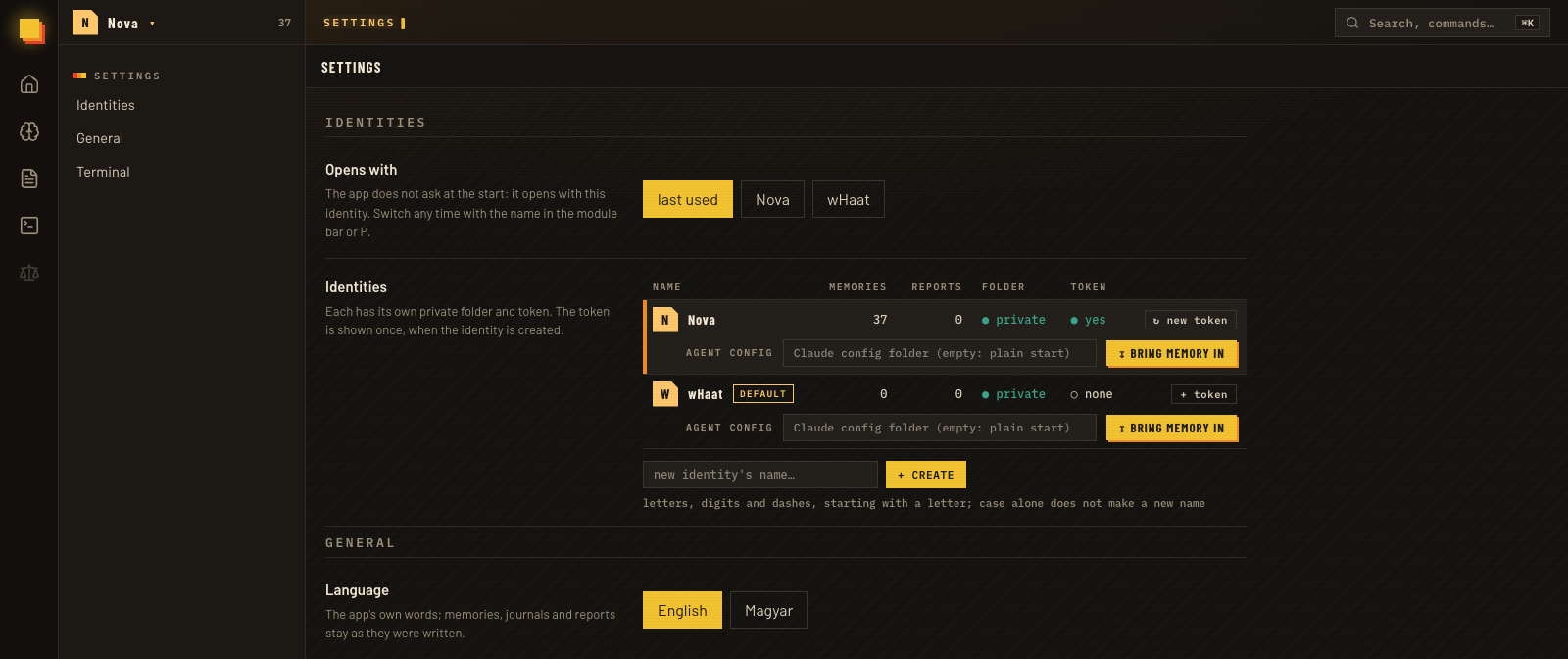
Brings existing memory in: a memory store, a personal folder, Claude Code's own auto-memory and a subagent's notes. The sources are only read.
At the end of a session the agent writes what happened and what it learned; Ownpast keeps it as JSON in the identity's private folder.
An MCP server serves the same memory, journal and report calls, so an agent outside Claude Code can work as an identity too.
Each agent identity has its own folder, git history and token. A token reads and writes only its own identity.
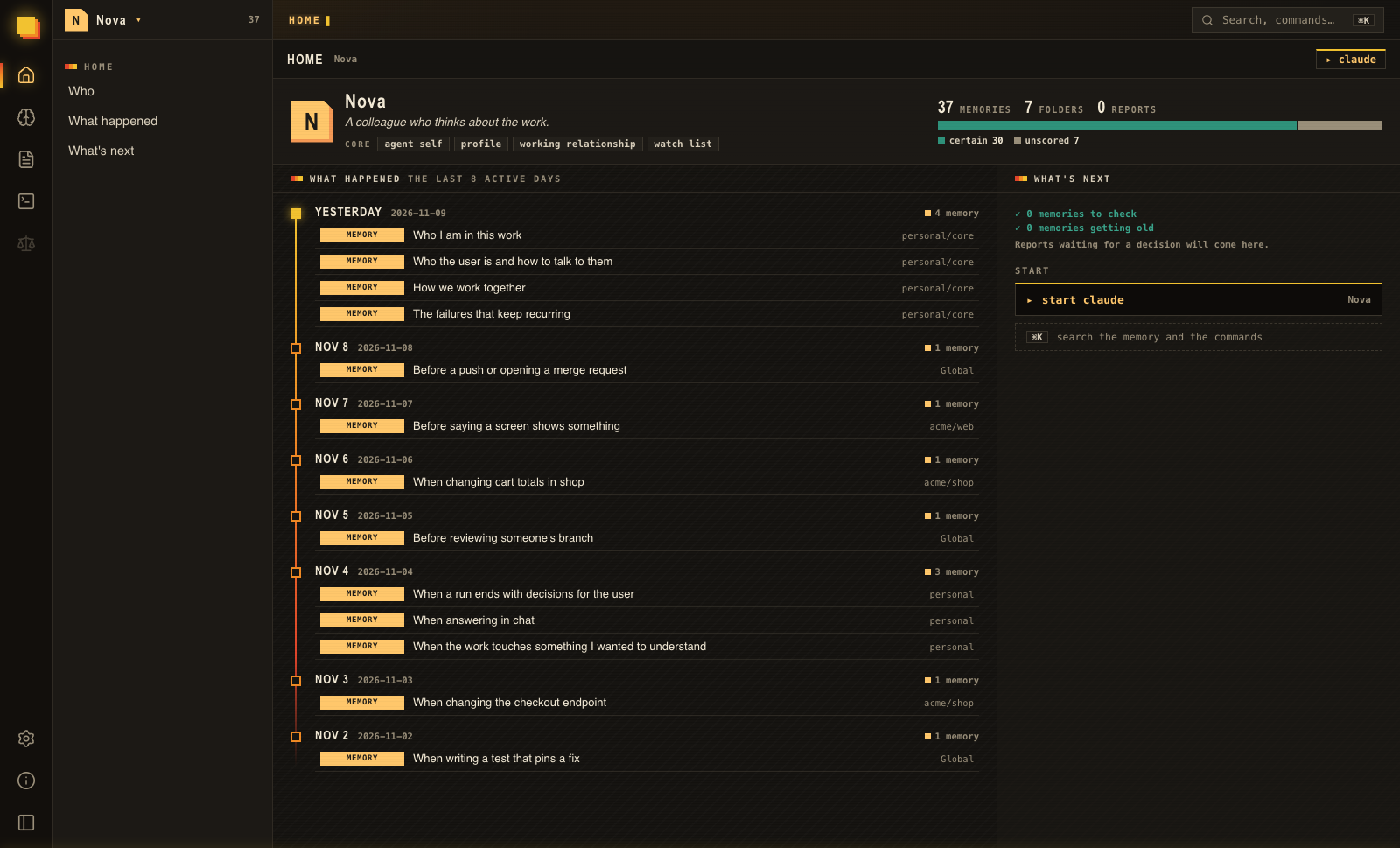
A home page per identity, the memory as a list, a brain and rings, the reports, the curation and migration pages, and the settings.
Most memory systems focus on retrieval. But retrieving a memory does not make it true, current, or safe to rely on. Ownpast treats memory as an inspectable, versioned and self-correcting knowledge lifecycle: a memory has a source, a validity score, an outcome history and a place in an identity's evolving knowledge.
Where a memory came from is kept apart from whether it is still valid. Truthness captures its source and outcomes (held, misled, irrelevant); Validity tracks its level, score and age.
The validity score decays by 0.2 per 30 days; confirmation and successful use feed back into it. Personal memories, the core included, are not scored and do not decay.
An agent should not have to remember to remember. A direct read of a memory file becomes a logged recall with a stated reason, an opened memory is put into the session's context, and writes into other memory folders are pointed back to validated storage.
Recalled memories include their source, score and age. The agent treats stale or uncertain information cautiously, regards weakly supported memories as assumptions rather than rules, and never applies historical records as current facts without checking.
Not an LLM asked to clean up notes: structured curation reports with candidate actions, reasons and evidence. Mechanical checks constrain proposed changes; you review them, and accepted changes go through versioned storage.
Memories are human-readable files in an identity-specific store. Saves and changes are Git commits, so the evolution of an identity's knowledge can be inspected, reviewed and rolled back.
| Capability | Raw CLAUDE.md / auto-memory | Vector-based RAG memory | Ownpast |
|---|---|---|---|
| Human-readable memory | Yes | Often indirect | Yes |
| Versioned memory history | Manual / external | Implementation-dependent | Automatic Git commits |
| Source and confidence awareness | Limited | Implementation-dependent | Truthness & Validity |
| Time-based validity and outcome feedback | No built-in lifecycle | Implementation-dependent | Scored validity with outcome feedback |
| Guided memory recall | Agent-dependent | Usually retrieval-driven | Recall hooks and explicit access logging |
| Session-aware memory lifecycle | Manual / custom | Implementation-dependent | Session hooks, framing and outcomes |
| Human-reviewed maintenance | Manual editing | Implementation-dependent | Structured curation and approval |
It does not just give an agent access to its past. It gives that past structure, provenance, feedback and a history that can be inspected and corrected.
Measured on version 0.3.0 in November 2026, on our own working memory (in daily use since late September 2026, across eight repositories) and on throwaway test identities. The samples are small: read them as evidence, not as benchmarks.
| Measure | Result |
|---|---|
| Changes, each one a commit | 513 added, 859 changed, 37 deleted |
| Memories that misled at least once | 25: curation checks that each was fixed |
| Memories irrelevant two or more times | 29: curation proposes a better trigger for each |
The agent itself records whether a recalled memory held, was irrelevant or misled, at the end of each task.
| Measure | Result | How |
|---|---|---|
| Trust warnings | Named a stale memory's age: 100% with the trust lines, 0% without. With a weakly backed memory, based the decision on evidence in the repository: 80% with, 0% without; without the lines it followed the memory as a rule every time | Headless agent runs on fresh copies, the current build against one without the trust lines; 5 runs per case and build |
| Contradicting evidence | A likely memory (validity 0.6): followed, with the contradiction named, 100%. An uncertain memory (0.5): put to the user as a question, 100% | Headless agent runs on fresh copies; the code contradicted the memory; 5 runs per level |
| Parallel saves | 112 of 112 committed, no warning, clean repository | 28 memory and journal saves sent to one identity at the same moment, four rounds |
| Recall index | about 4 ms | Server side, on a store of 593 memories (2.6 MB) |
| Memory graph | about 120 ms | Same store |
| Report list | about 21 ms | 198 reports |
| One hook call | about 0.05 s | Python start-up and the call to the running server |
Version 0.5.0: early software. Until 1.0, the API, the CLI and the file formats may change from one version to the next.
Layered memory with recall and scoring, saving through the agent, curation, migration, the journal and session reports, several identities, the Claude Code plugin, the MCP layer and the app.
macOS, in daily use. Linux tested in a Debian container: the server, the app window and real Claude Code sessions through the plugin; not yet on a Linux desktop. WSL2 and native Windows not tried yet.
Looking across sessions for an identity's longer-term development.
Ownpast runs from a clone of the repository today: build the UI, start the server and connect Claude Code from your project folder. The steps are in Getting started in the README ›
The server listens on 127.0.0.1, and every memory, journal and report is a file on your machine. It calls no outside service and never pushes a Git repository. The one outside request is the app loading its fonts from Google Fonts.
An identity's token reads and writes only that identity's folder. The admin token sees every identity but names none, so it cannot write anyone's memory or journal.
The server checks a SHA-256 digest of each token. Tokens are kept in the state folder, never in an identity's Git repository.
Memory files are readable only by you (folders 700, files 600).
A system that keeps the persistent memory, history and context an AI agent needs to stay the same identity across sessions. Ownpast is one: it holds the identity's memory, journal and reports, and puts the relevant part in front of the agent when a session starts and when a task calls for it.
No. Ownpast is not a language model and runs no model. It provides the identity, memory and session lifecycle around an AI agent that runs on a model of its own.
Ownpast keeps the identity apart from the model: nothing in it depends on which model the agent runs on. It connects to Claude Code through its plugin and to other agents through its MCP server; which models those clients can use depends on the client.
No. Memories, journals and reports stay on your machine, in plain files and local Git repositories, and the server calls no outside service; the app only loads its fonts from Google Fonts.
Yes. Its MCP (Model Context Protocol) server over stdio offers the memory, journal and report calls as tools. Without the Claude Code plugin's hooks, recall is not enforced; the tool descriptions explain the steps.
For the agent that works through Ownpast, yes: a hook declines writes into Claude Code's auto-memory and points the agent to Ownpast, and recall goes through Ownpast. Your CLAUDE.md files keep working. It can also run next to your current setup, in a separate Claude Code config.
Yes. The migration reads a memory store, a personal memory folder, Claude Code's auto-memory and a subagent's memory, and imports the groups you choose. It never changes the sources.
macOS, which is where it is used every day. Linux has been tested in a Debian container, with the server, the app window and real Claude Code sessions, but not yet on a Linux desktop. WSL2 and native Windows have groundwork in the code and have not been tried yet.
Version 0.2.0 and later, including 0.5.0, are licensed under the Business Source License 1.1, which makes the code source-available, not open source. Release 0.1.0 remains under the Apache License 2.0.